What is the importance of vibration damping in machinery? This question matters wherever motors, pumps, compressors, and gearboxes operate continuously. Uncontrolled vibration travels through bearings, shafts, housings, and concrete floors. It creates noise, loosens fasteners, increases heat, and accelerates fatigue. A small oscillation can become a costly failure when nobody tracks its pattern.
The U.S. Department of Energy’s Operations & Maintenance Best Practices guide links predictive maintenance with lower downtime and improved maintenance economics. Its reported ranges include 35–45% less downtime and 8–12% lower maintenance costs. These figures are not guarantees. Results depend on machine design, sensor placement, operating load, and staff skill. ISO 20816 also provides structured guidance for evaluating machine vibration, giving engineers a practical reference for condition assessment.
Vibration analyst and Mobius Institute founder Jason Tranter describes the principle simply: “Vibration is the language of machines.” Damping helps reduce that language before it becomes destructive. Rubber mounts, tuned absorbers, resilient couplings, and properly designed foundations can limit transmitted energy. The correct solution is not always the softest mount. Excessive flexibility may create alignment problems or resonance. That detail is easy to overlook.
A reliable damping strategy combines field experience, measurement, and engineering judgment. Infrared checks, spectrum analysis, and trend data can reveal whether damping is working. Still, every machine behaves differently. That uncertainty deserves attention. This article examines the evidence, practical methods, and design decisions behind effective vibration control in modern machinery.
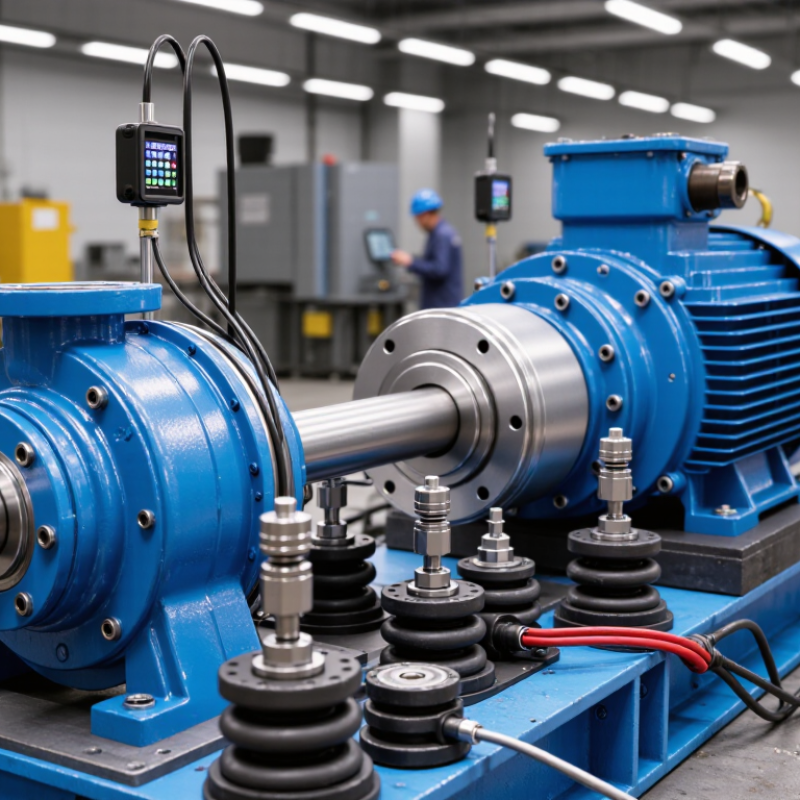
Vibration damping in machinery is the process of reducing oscillation energy before it causes excessive movement, noise, or damage. Rotating shafts, gears, pumps, and motors all produce vibration during operation. Some vibration is normal. Excessive vibration is not.
A damping material absorbs part of this mechanical energy and converts it into small amounts of heat. Rubber mounts, viscous dampers, friction joints, and tuned damping elements can control movement in different ways. The correct choice depends on operating speed, load, temperature, and the machine’s natural frequency. A soft mount may isolate vibration effectively, but it can also allow too much movement during startup. That trade-off is often missed.
In practical maintenance work, technicians usually begin with an accelerometer, visual inspection, and operating history. A machine that vibrates strongly near one speed may be approaching resonance. Loose foundation bolts, misalignment, worn bearings, and uneven loads can create similar symptoms. Damping will not repair every fault. Sometimes, it only hides the warning temporarily. That is a serious limitation.
Measurements should be taken before and after any damping change. Record vibration amplitude, frequency, temperature, and load conditions. A simple comparison is useful, but one reading is rarely enough. Real machinery changes with wear, lubrication, and production demand. Even experienced engineers can choose an imperfect solution when the operating data is incomplete. That is why damping design requires testing, adjustment, and honest review.
A practical engineering data table covering vibration sources, damping methods, measurable effects, and selection considerations.
| Machinery Area | Typical Vibration Source | What Vibration Damping Does | Common Damping Method | Typical Performance Indicator | Operational Benefit | Key Limitation |
|---|---|---|---|---|---|---|
| Rotating Equipment | Rotor imbalance, shaft misalignment, looseness, or bearing defects | Reduces resonant response and limits vibration energy transmitted to the frame and bearings | Viscoelastic mounts, tuned absorbers, resilient couplings, and structural stiffening | Velocity RMS commonly assessed in mm/s | Lower bearing loads, reduced noise, and improved operating stability | Damping cannot correct severe imbalance or misalignment |
| Pumps and Fans | Hydraulic pulsation, cavitation, blade-pass forces, and flow turbulence | Absorbs cyclic motion before it reaches piping, supports, and nearby equipment | Elastomeric isolators, flexible connectors, inertia bases, and pulsation dampers | Vibration frequency often follows running speed or blade-pass frequency | Fewer pipe-joint failures and less structural fatigue | Soft mounts may increase movement during start-up or shut-down |
| Gearboxes | Gear-mesh forces, tooth wear, backlash, and torque fluctuations | Controls transmission of gear-mesh energy through the housing and machine base | Constrained-layer damping, housing treatment, torsional dampers, and optimized mounts | Acceleration spectrum used for gear-mesh fault detection | Lower acoustic noise and slower fatigue accumulation in housings and fasteners | Excess damping can increase heat generation in some components |
| Machine Tools | Spindle imbalance, cutting-force variation, tool chatter, and slide motion | Suppresses regenerative chatter and limits displacement at the cutting tool | Polymer-concrete bases, tuned mass dampers, damping slides, and active control | Displacement and acceleration near the cutting zone | Improved surface finish, dimensional accuracy, and tool life | Effective treatment depends strongly on the operating speed and tool setup |
| Compressors | Reciprocating forces, pulsating gas flow, valve impacts, and piping resonance | Reduces dynamic forces transferred to the skid, foundation, and connected pipework | Inertia blocks, spring isolators, pulsation bottles, and pipe supports with damping | Displacement, velocity, and pulsation pressure | Reduced fatigue cracking, noise, and maintenance interruptions | Pressure pulsation requires system-level analysis, not only mount damping |
| Conveyors and Drives | Motor torque ripple, belt or chain engagement, roller eccentricity, and impacts | Attenuates shocks and prevents repeated force transmission into the supporting structure | Elastomeric couplings, damped drive bases, shock absorbers, and resilient stops | Peak acceleration and impact response | Smoother starts, reduced fastener loosening, and longer component life | Material properties change with temperature, frequency, and aging |
| Reciprocating Machinery | Unbalanced inertia forces, piston motion, crankshaft torque, and firing pulses | Converts vibratory energy into heat and reduces structure-borne force transmission | Dynamic balancing, tuned dampers, high-damping mounts, and rigid foundations | Force amplitude and vibration phase relative to crank angle | Lower foundation loads and reduced risk of fatigue in connected systems | Incorrect tuning can amplify vibration near resonance |
| Precision Instruments | Floor vibration, nearby rotating machinery, acoustic excitation, and thermal movement | Isolates sensitive equipment from low-amplitude environmental vibration | Air springs, passive isolation platforms, damping pads, and active isolation | Vibration measured in displacement or acceleration over frequency | Improved measurement repeatability and image or signal quality | Isolation performance may be poor above the system’s usable frequency range |
| Structural Frames | Periodic machine forces, impact loads, flexible members, and resonance | Raises energy dissipation and reduces vibration amplitude at structural natural frequencies | Viscous dampers, friction dampers, constrained-layer panels, and added bracing | Damping ratio, modal response, and natural frequency | Lower stress cycles, improved operator comfort, and less transmitted noise | Added mass or stiffness can shift resonance to another operating range |
| Bearings and Supports | Rolling-element defects, lubrication problems, shaft loads, and housing flexibility | Limits vibration amplification and reduces the dynamic load carried by the support | Internal bearing damping, compliant supports, squeeze-film dampers, and optimized fits | Acceleration envelope and bearing defect frequencies | Earlier fault detection and reduced risk of secondary damage | Damping is not a substitute for correct lubrication, clearance, or alignment |
| General Industrial Systems | Resonance caused by excitation frequency approaching a natural frequency | Reduces peak response by dissipating energy and increasing the effective damping ratio | Viscoelastic materials, viscous dashpots, friction interfaces, and tuned mass dampers | Damping ratio is commonly expressed as a percentage | More stable operation, lower noise, and improved service reliability | Material selection must consider temperature, frequency, load, and chemical exposure |
Engineering note: Actual vibration limits and damping performance must be established from the machine type, operating speed, load, foundation, measurement location, frequency range, and applicable maintenance or machinery-vibration standard.
It often starts with imbalance, a loose fastener, a worn bearing, or a misaligned shaft. Small faults can grow quickly.
Vibration travels through shafts, housings, couplings, foundations, and connected pipework. Rigid metal paths usually transmit energy efficiently.
Yes. Energy can travel from another machine through shared structures. Nearby equipment may appear healthy but still move noticeably.
Resonance occurs when forcing frequency approaches a support system’s natural frequency. Modest excitation can then create surprisingly large movement.
Compare vibration velocity, frequency, speed, load, and temperature. Check bearings, frame panels, mounts, and support structures.
No. A dominant running-speed peak often suggests imbalance, but field inspection must confirm it. Load and speed changes can mislead.
Measure the problem before choosing a material. Consider frequency, load, temperature, oil exposure, available space, cleaning, and mounting stiffness.
No. Excessive softness may increase movement, misalignment, or coupling stress. Uneven compression can create fresh vibration and reduce service life.
Measure vibration again under realistic load and temperature conditions. Check startup, shutdown, and normal operation. Field adjustment may still be necessary.
Yes. A pad may quiet the casing while internal stress continues. Correct the source, check alignment, and understand the transmission path. Mistakes happen.
Vibration damping in machinery refers to reducing or absorbing unwanted oscillations generated by moving parts, rotating components, impacts, or external forces. These vibrations can travel through shafts, bearings, frames, foundations, and connected equipment, gradually affecting the entire system. Understanding what is the importance of vibration damping in machinery helps explain why controlling vibration is essential for stable and reliable operation.
Effective damping improves equipment performance by reducing noise, wear, fatigue, alignment problems, and unexpected downtime. Common approaches include using resilient mounts, isolation pads, tuned absorbers, flexible couplings, structural reinforcement, and improved maintenance practices such as balancing and alignment. The most suitable solution depends on vibration frequency, operating speed, load, temperature, installation conditions, and the machine’s structural design. A practical damping strategy should control vibration without restricting necessary movement, creating excessive heat, or interfering with normal equipment operation.

 Royflexa Rubber